 Warning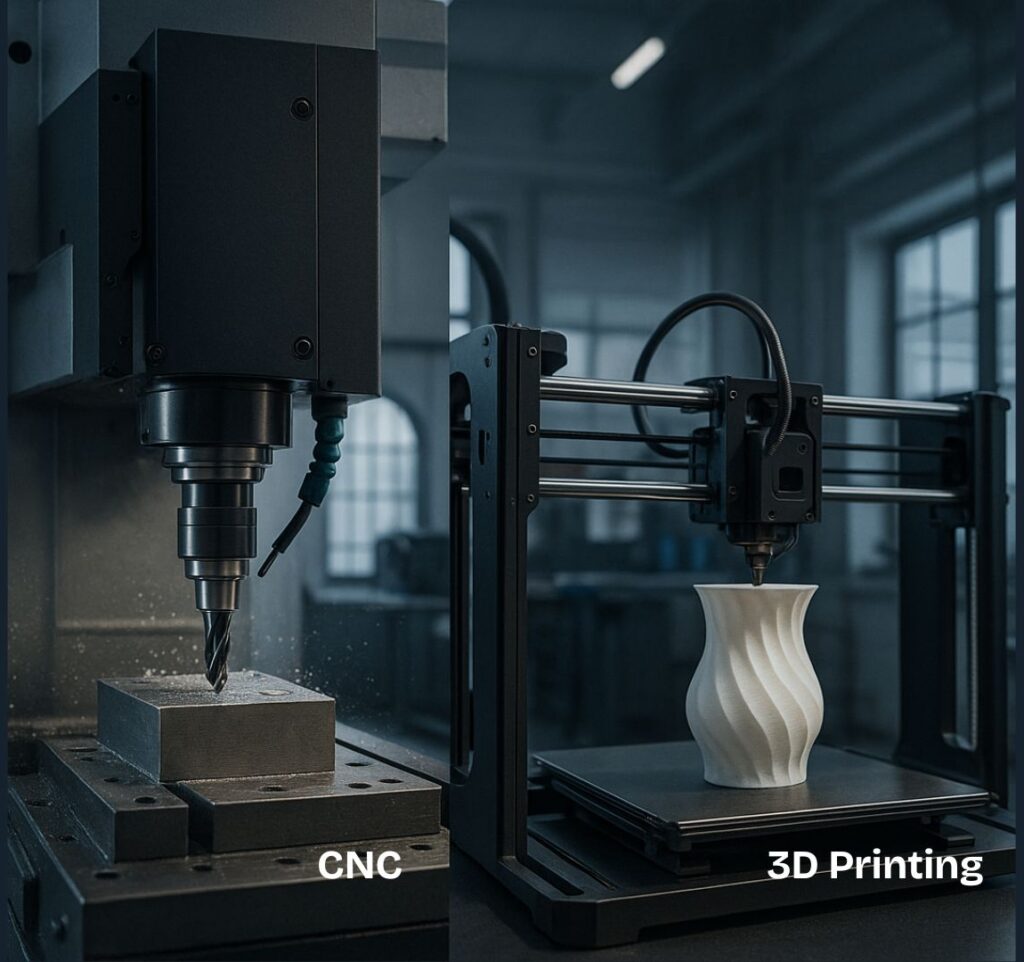
Blog
Choosing the proper method for prototyping can directly impact how quickly and efficiently your product reaches the market. CNC machines and 3D printers are two of the most widely used technologies in modern product development, particularly for startups and tech-forward teams. Each brings a unique set of capabilities and constraints to the table. In this guide, we’ll break down how both approaches compare regarding speed, materials, precision, and cost, helping decision-makers choose the most effective tool for each phase of the prototyping process.
Comparing Production Speed
Both CNC machines and 3D printers offer quick turnaround options. 3D printing, particularly FDM or SLA, can produce visual models in just a few hours, making it ideal for early-stage brainstorming, internal design reviews, and aesthetic validation. However, CNC processes often deliver superior speed when producing parts that require machining from common stock materials and can turn around functional parts in under 72 hours, often faster if the part is simple or uses readily available materials.
For teams under pressure to validate mechanical properties or finalize fit and assembly, CNC’s production speed often beats 3D printing for critical components.
Material Capabilities
Material range is one of the main differences between these two approaches. 3D printers are mostly restricted to using plastics: PLA, ABS, PETG, or resins, but in more advanced applications, they use composite filaments or certain types of metals. These can, however, not be used at all times in mechanical testing as they do not have enough strength and durability. On the other hand, CNC machines can operate on a much broader range of tough materials. Standard materials are aluminum, stainless steel, brass, titanium, and engineering plastics such as PEEK and Delrin.
This makes CNC a more suitable option for engineering validation and early functional testing. You’re not only testing form, you’re testing actual function under mechanical stress.
Surface Finish and Precision
When surface quality matters, CNC machining often wins for its superior precision and finish. It offers tight tolerances (as low as ±0.001″), allowing for accurate, repeatable part production. CNC surface finishes are generally clean and smooth, often production-grade. In comparison, most 3D-printed parts require sanding or coating to smooth out layer lines, and the dimensional tolerances are less predictable.
Cost Considerations
3D printers are cheaper for visual prototypes, rough prototypes, early-stage mockups, and prototypes that are merely visual. They are suitable for single-use items since little to no setup cost is involved. Nevertheless, as soon as durability and functionality are concerned, CNC becomes more cost-efficient since there are fewer iterations and greater accuracy. It also does not require any post-processing, taking up time and money.
The best path is often hybrid: print to learn, machine to prove. Pick per-part based on tolerance, strength, finish, cost, and lead time.